
Academics
Curriculum and assessment
We teach the Ghana Education Service curriculum — the Standards-Based Curriculum from Kindergarten to Basic 6, and the Common Core Programme for Basic 7 to Basic 9. This page sets out exactly how that works in practice.
- KG – Basic 6
- Standards-Based Curriculum
- Basic 7 – Basic 9
- Common Core Programme
- Exit examination
- BECE, set by WAEC
What we teach
Two national curricula, one continuous path
Both are set by the Ghana Education Service. We do not run a parallel foreign curriculum alongside them, and we do not skip the parts that are harder to resource.
Standards-Based Curriculum
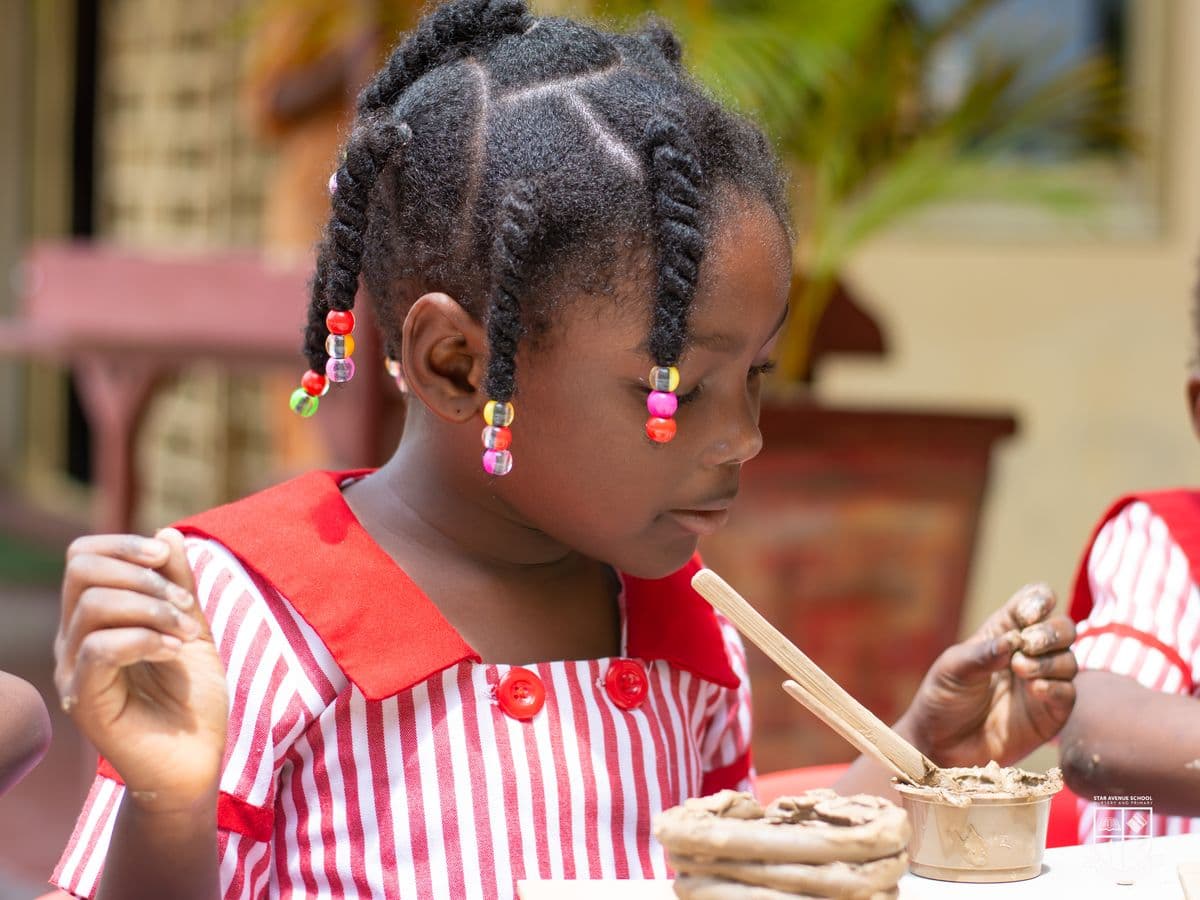
Introduced by the GES for Kindergarten through Basic 6. It is organised around learning standards and indicators rather than a list of topics, and it expects pupils to be doing things — investigating, making, presenting — not only writing.
- Core learning areas: Language and Literacy, Numeracy, Science, Our World Our People, Creative Arts, Ghanaian Language, RME, Computing, PE
- History and French are added from Basic 4
- Learner-centred: pupils work in groups, present, and record their own investigations
- Assessment is continuous as well as terminal
Common Core Programme
The GES programme for Junior High. It carries ten subjects and ends with the Basic Education Certificate Examination, administered by WAEC at the end of Basic 9.
- Ten subjects: English, Mathematics, Integrated Science, Social Studies, Ghanaian Language, RME, Computing, Creative Arts and Design, Career Technology, French
- School-Based Assessment carries half the termly mark
- Four full mock examinations in Basic 9, marked to WAEC standards
- Placement into senior high school through the CSSPS
Subjects
What is on the timetable, section by section
Preschool
Creche · Nursery 1–2 · KG 1–2
- Language and Literacy
- Numeracy
- Our World, Our People
- Creative Arts
- Physical Development
- Music and Movement
- Ghanaian Language (Ga / Twi)
Lower Primary
Basic 1 · Basic 2 · Basic 3
- English Language
- Mathematics
- Science
- Our World, Our People
- Ghanaian Language (Ga / Twi)
- Religious and Moral Education
- Creative Arts
- Computing
- Physical Education
- French (from Basic 3)
Upper Primary
Basic 4 · Basic 5 · Basic 6
- English Language
- Mathematics
- Science
- History
- Our World, Our People
- Ghanaian Language (Ga / Twi)
- Religious and Moral Education
- Creative Arts
- Computing
- French
- Physical Education
Junior High School
Basic 7 · Basic 8 · Basic 9
- English Language
- Mathematics
- Integrated Science
- Social Studies
- Ghanaian Language (Ga / Twi)
- Religious and Moral Education
- Computing
- Creative Arts and Design
- Career Technology
- French
Assessment
How a termly mark is made up
In line with GES guidance, half of the termly mark comes from work done across the term and half from the end-of-term examination.
| Component | Weight | What it covers |
|---|---|---|
| Continuous assessment | 50% | Class exercises, homework, projects, class tests, practical work |
| End-of-term examination | 50% | Sat in the final week of each term, in every subject |
| Mid-term grade sheet | — | Sent home in week six. Not part of the mark; an early warning |
| Half-term reading check | — | Basic 1–3 only. Reading age reported to parents in writing |
Basic 9 examinations follow the BECE format from Basic 8 onwards, so that the paper itself is never the unfamiliar part.
Homework
How much, and why that much
Homework here is short, regular and mostly reading. A child who reads at home for twenty minutes a night gains more than one who fills in worksheets until nine o'clock.
| Class | Expected time | What it looks like |
|---|---|---|
| Creche – Nursery 2 | None | A story read to them at home is the only homework we ask for |
| KG 1 – KG 2 | 10 minutes, 3 nights | Reading with a parent, plus one short task |
| Basic 1 – Basic 3 | ~30 minutes, 4 nights | 20 minutes reading plus one written task |
| Basic 4 – Basic 6 | 45–60 minutes, 4 nights | Managed by the pupil through the homework diary |
| Basic 7 – Basic 9 | 60–90 minutes, 5 nights | Subject homework on a published weekly timetable |
If homework is regularly taking your child much longer than the times above, tell the class teacher. It usually means the work is pitched wrongly, and that is ours to fix.
Reporting
What you hear, and when
Four fixed points of contact a term, plus a phone call any time something changes.
Week six — mid-term grade sheet
A single sheet with a grade per subject and a one-line comment. It exists so that nothing in the end-of-term report is a surprise.
End of term — full report card
Continuous assessment and examination marks, a subject comment from each teacher, a class-teacher comment and an attendance record.
Last day of term — collected in person
Reports are handed over at the parent–teacher meeting, not sent home in a bag. A second window opens the following Monday morning.
Any time — before it becomes a problem
If a child's work drops off, the class teacher calls. We would rather have an awkward conversation in week three than a difficult one in week twelve.
Admissions
Come and see a lesson
The quickest way to judge a curriculum is to watch it being taught. Tours run on Tuesday and Thursday mornings, in term time, with classes in session.
Prefer to talk first? Call or WhatsApp +233 26 150 4477 — the admissions office answers from 7:00am to 4:00pm.